Feature Films: A History of Horror
Horror films, in my opinion, are an art-form, and true mastery over horror requires mastery of all aspects of filmmaking. Every detail, from sound design to lighting, is done to promote a singular effect: to frighten and has to be done precisely, if not the whole movie will fail to achieve its goal. While I may be a little biased about it, I think every filmmaker should try their hand at horror, to hone their craft in the very least.
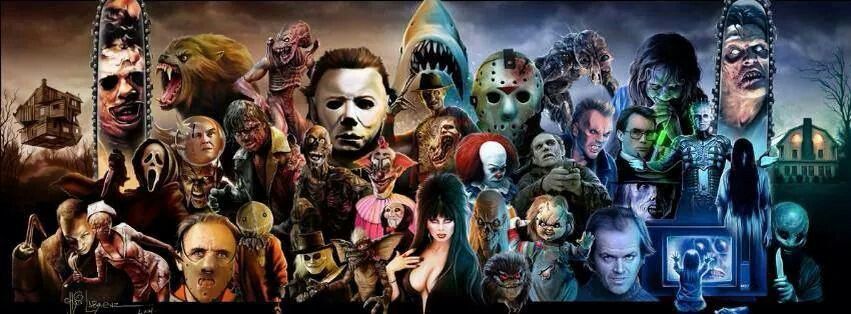
There are three distinct golden eras in horror films, and we are burgeoning on a fourth. Interestingly enough, the golden era of horror has corresponded with major historical times of despair and overall dreariness. The first golden age, the Universal Age, grew out of the great depression, the Hammer Films Age stemmed from the Cold War era, and the Auteur Age stemmed from the Vietnam war. The current golden age comes from the entirely crazy world we live in, the divided, Trump era.
Then
The first golden age of horror is known as the Universal Era, named after Universal Studios. Universal is arguably responsible for making horror films more popular, but they didn't set out to do that. During the Great Depression, fewer people were attending the cinemas which resulted in smaller budgets for filmmakers. Enter Dracula. In 1924 Dracula was a popular stage play in the European circuit and Carl Laemmle, Jr., the son of the founder of Universal Studio saw it's potential as a movie. Because of its origins as a stage play, the production could be small, with large amounts of dialogue being the main focus of the film. Laemmle even brought in the actor from the stage play to reprise his role as Dracula: Bela Lugosi.
Dracula was an immediate success. Which lead to Universal producing another iconic film: Frankenstein--which had even greater success. While Dracula was mysterious and gothic, Frankenstein was much more gothic and macabre. Though Frankenstein was not without controversy (The Monster killing a young girl), it paved the path for horror films and star Boris Karloff for even greater success. Universal followed up these successes with The Wolf Man, The Invisible Man, The Mummy, and others. While other studios produced iconic horror films in this time, Universal Studios takes the cake with the most popular films.


There are three distinct golden eras in horror films, and we are burgeoning on a fourth. Interestingly enough, the golden era of horror has corresponded with major historical times of despair and overall dreariness. The first golden age, the Universal Age, grew out of the great depression, the Hammer Films Age stemmed from the Cold War era, and the Auteur Age stemmed from the Vietnam war. The current golden age comes from the entirely crazy world we live in, the divided, Trump era.
Then
The first golden age of horror is known as the Universal Era, named after Universal Studios. Universal is arguably responsible for making horror films more popular, but they didn't set out to do that. During the Great Depression, fewer people were attending the cinemas which resulted in smaller budgets for filmmakers. Enter Dracula. In 1924 Dracula was a popular stage play in the European circuit and Carl Laemmle, Jr., the son of the founder of Universal Studio saw it's potential as a movie. Because of its origins as a stage play, the production could be small, with large amounts of dialogue being the main focus of the film. Laemmle even brought in the actor from the stage play to reprise his role as Dracula: Bela Lugosi.
Dracula was an immediate success. Which lead to Universal producing another iconic film: Frankenstein--which had even greater success. While Dracula was mysterious and gothic, Frankenstein was much more gothic and macabre. Though Frankenstein was not without controversy (The Monster killing a young girl), it paved the path for horror films and star Boris Karloff for even greater success. Universal followed up these successes with The Wolf Man, The Invisible Man, The Mummy, and others. While other studios produced iconic horror films in this time, Universal Studios takes the cake with the most popular films.
Boris Karloff (Right) and Bela Lugosi (Left)
The second golden age of horror is the Hammer Films age, again named after the then prominent Brittish studio, Hammer Films. In the 1940's and early 1950's horror films were on a decline into childish mediocrity and science fiction began to be more popular. However, in 1956, in the height of the Cold War, a low budget film studio, Hammer Films burst onto the scene with their hit, The Curse of Frankenstein, which starred Peter Cushing as Victor Frankenstein and Christopher Lee as The Monster. While keeping the traditional gothic style and influence, Hammer Films added two iconic elements to their films: blood and sexuality.
Hammer Films followed up The Curse of Frankenstein with The Horror of Dracula, again starring Peter Cushing as Van Helsing and Christopher Lee as Dracula. The mix of gothic, blood, and sexuality again made the film a huge hit and became the formula for many of the horror films during this era.
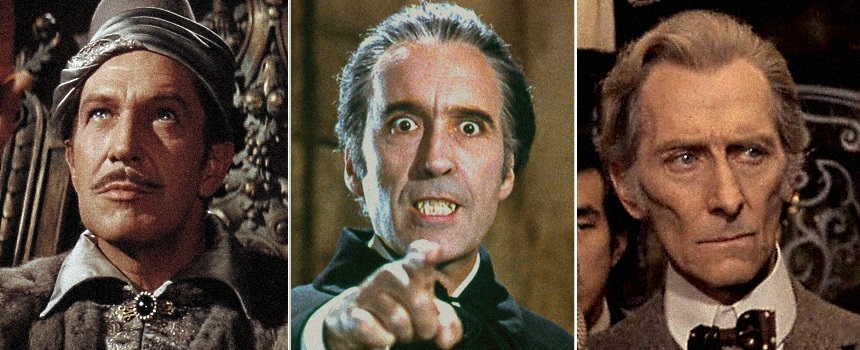
During this time, another iconic horror actor was frightening audiences back in America: Vincent Price. After spending the early years of his career in drama films, Price found a welcome home in horror movies in 1953 with the film House of Wax. He then starred in films such as The Fly, The House on Haunted Hill, and The Last Man on Earth as well as numerous films based off Edgar Allen Poe stories. Yet the formula for all these stayed the same: gothic styles, gallons of blood, and not so subtle sexuality.
Vincent Price (Left), Christopher Lee (Middle), and Peter Cushing (Left)
The third golden age of horror, The Auteur age, sees a departure from any specific studio making the majority of horror films and goes to a director-led, independent age. The iconic horror filmmakers of this era grew up in Vietnam era America, the counter-culture, and the hippie movement. With the amount of cultural upheaval happening in the late 1960's and 1970's, its no wonder that the movies that came out of this era are touted as some the best horror films to be made.
The directors of this era pushed the envelope and put as much gritty, visceral violence and sexuality with their films. Gone were the ways of gothic horror--realistic horror reigned supreme. This is the era that brought us The Texas Chainsaw Massacre, The Exorcist, and Halloween, all films that would have been banned if they came out just a decade earlier.
Now considered masters of the craft--auteurs--the directors of the 70s were just beginning to make their mark on the world. Tobe Hooper, George A. Romero, Wes Craven, John Carpenter, and David Cronenberg are, perhaps, the most iconic of this era. Their experimentation, innovation, and brilliance dominated the box office and brought horror out of the campy, B-Movie place where they originated.
A tribute to Tobe Hooper, George A. Romero, and Wes Craven by Kyle Bures
Now
The 2010s launched a new golden age of horror movies, gaining much more traction towards the middle of the decade--a decade that has been pockmarked with division and hate. It is thought that the resurgence of horror in the last few years is a direct result of streaming services and digital availability.
The 2010s launched a new golden age of horror movies, gaining much more traction towards the middle of the decade--a decade that has been pockmarked with division and hate. It is thought that the resurgence of horror in the last few years is a direct result of streaming services and digital availability.
In the late 1990s and 2000s, horror films became more formulaic and complacent. Mimicking the slump in the 1940s and early 1950s, horror films were mostly sequels or just plain meh, save for a few standouts like Saw and The Devil's Rejects. Many of films that broke the formula were given the death sentence called: "Direct to Video". However, with the rise of streaming services, movies that had a limited theatrical release could exponentially increase their viewership with sites like Netflix, Hulu, and Shudder (a horror dedicated OTT streaming service). One of the best examples of this is The Babadook, which is regarded as one of the best horror films in the last decade.
Recently we have seen standout horror films work wonders in the box office, beating out more traditional genres. Movies such as IT and A Quiet Place were some of the most popular horror films. The film Hereditary and Annihilation, both of which came out in 2018, provided some scares that will eventually become iconic, though the movies are anything but formulaic. Get Out even won an Oscar, a feat that only one other horror film has achieved (That movie being Silence of the Lambs).
Later
Future horror films will be able to stand tall on the foundation set by the movies made in the last few years. While some horror films still have been going the traditional sequel route, others have built a successful cinematic universe, namely The Conjuring series which has spin-offs like Annabel and The Nun. Yet many others are amazing stand-alone films that will stand the test of time. Additionally, we see the emergence of another horror auteur in James Wan, who directed Saw, The Insidious Trilogy, and both the Conjuring films. Jordan Peele, who directed Get Out, seemed to be well on his way to becoming an auteur as well. We may be seeing the beginning of a golden age, or maybe we are seeing the emergence of horror as a pillar of modern movie making.
Future horror films will be able to stand tall on the foundation set by the movies made in the last few years. While some horror films still have been going the traditional sequel route, others have built a successful cinematic universe, namely The Conjuring series which has spin-offs like Annabel and The Nun. Yet many others are amazing stand-alone films that will stand the test of time. Additionally, we see the emergence of another horror auteur in James Wan, who directed Saw, The Insidious Trilogy, and both the Conjuring films. Jordan Peele, who directed Get Out, seemed to be well on his way to becoming an auteur as well. We may be seeing the beginning of a golden age, or maybe we are seeing the emergence of horror as a pillar of modern movie making.
Comments
Post a Comment